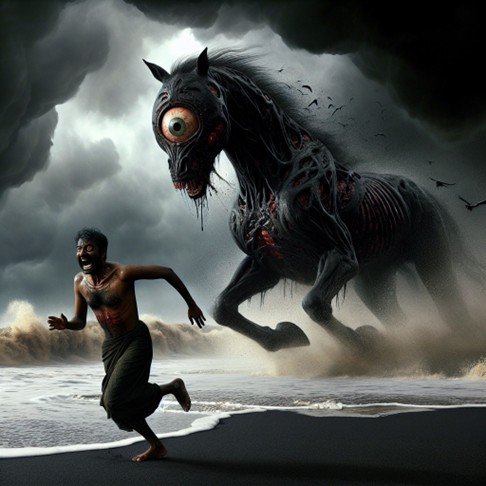
The Orkney Islands lie low against the North Sea like stones flung from a giant’s sling. In winter the wind howls straight from Norway, carrying salt and ice that scours the skin raw. On the island of Rousay, in the year when the kelp trade failed and the herring shoals vanished, the people spoke of the Nuckelavee in whispers that barely rose above the gale. They said it had been restless since the old sea-mother had gone quiet, and when the Nuckelavee woke, no roof could keep it out and no charm could hold it long.
Tammas Taylor was a fisherman of Stronsay, broad-shouldered and steady, with a wife named Morag and three small children who still slept curled together like otters. He had fished the same grounds his father had, and his father before him. But that autumn the sea turned sullen. Nets came up empty or torn. The cows in the byre sickened, their milk running thin and bloody. Blight blackened the bere fields overnight. Folk said it was the Nuckelavee’s breath on the wind — poison that withered flesh and crop alike.
Tammas did not believe in such things until the night he walked home late from the shore. The moon was hidden behind wrack clouds, the path a pale ribbon between black ditches. He carried a creel of limp crabs, the only catch worth keeping. The wind dropped suddenly, as though the air itself held its breath. Then came the smell: rotting seaweed, hot blood, and something fouler — sulphur and decay, the stench of a carcass left too long in the sun.
He stopped. Ahead, where the path met the beach, a shape loomed against the surf-line. At first he thought it a horse and rider, silhouetted black against the white foam. But the rider had no head separate from the beast. Man and horse were fused, one skinless horror. The flesh — raw, glistening red — pulsed over yellow sinews and black veins that throbbed like ropes. No hide covered it; every muscle twitched visible, every tendon strained. The horse-part had one huge eye, burning red as a forge coal, and fins along its forelegs that dripped black ichor. From the horse’s back rose the human torso — head too large, arms dangling long as oars, fingers ending in claws that scraped the air.
The Nuckelavee turned its single eye toward Tammas. No pupil, only a glowing pit. It exhaled — a long, wet hiss — and the breath rolled across the path like fog. Where it touched the grass, the blades curled black and died.
Tammas dropped the creel. The crabs scuttled into the dark. He ran. Behind him the creature moved — not galloping but flowing, a nightmare tide surging over the dunes. Its hooves struck no sound on the sand, yet the ground shook. The stench thickened until Tammas gagged. He bolted inland toward the low stone walls of his croft.
He burst through the door. Morag was at the fire, stirring kale broth. The children looked up from their rush mats. Tammas slammed the door and barred it with trembling arms. “Bar the shutters,” he gasped. “Light every candle. And pray.” Morag asked no questions. She had heard the tales too.
They worked in silence: shutters closed, peat heaped high until the flames roared, candles lit at every window until the room blazed like noon. The old charm — fresh water crossed with iron — was spoken over the threshold. Salt sprinkled in lines. Rowan branches hung above the lintel.
Outside, the wind returned, fiercer. Something heavy circled the house. Claws scraped stone. A low bubbling growl rose and fell like surf in a cave. The children whimpered. Morag held them close, whispering psalms. The Nuckelavee tested the walls. Its breath seeped under the door — thin tendrils of black mist that curled toward the fire and hissed as they met the heat. One candle guttered and died. The stench filled the room: blood, rot, the iron reek of plague.
Tammas stood by the door, axe in hand. The wood bulged inward as though pressed by a great weight. The bar groaned. Then came the voice — not spoken but felt in the bones — a wet, gurgling whisper that seemed to come from everywhere and nowhere. “Open… fisherman. Let me in. Your sea is empty. Your fields are dead. Your children hunger. I can end it.”
Morag crossed herself. Tammas gripped the axe tighter. “Away, foul thing. This house is shut to thee.” The pressure increased. The door cracked along the grain. Black ichor oozed through the splits, hissing on the flags. A child began to cough, a wet rattling sound.
Then Tammas remembered the old story his grandfather told — of the Nuckelavee’s hatred of fresh water. The creature could not abide it; the sea-mother had bound it so long ago. He seized the rain barrel in the corner — full from the morning’s downpour — filled a wooden bucket to the brim, and hurled the contents against the door.
A scream tore the night — high, inhuman, the sound of flesh boiling. The pressure vanished. Hooves retreated, scrabbling over stone. The stench faded. Silence fell, broken only by the crackle of the fire and the children’s sobs. They waited until dawn.
When grey light seeped through the shutters, Tammas opened the door a crack. The path was scorched black where the Nuckelavee had stood. Grass lay withered in a wide circle. But the creature was gone, returned to the sea that birthed it. The blight lifted slowly after that night. The cows recovered. The bere fields greened again, though thin. The herring returned the following season.
But Tammas never fished alone after dark again. On moonless nights he would sit by the fire, axe across his knees, listening to the wind. And in the deepest winter, when the sea-mother slept and the Nuckelavee stirred, the people of Rousay kept fresh water by every threshold, candles burning low, and doors barred tight.
They told the tale to their children, and the children to theirs: “Mind the Nuckelavee. It comes from the deep water, wearing no skin but its hate. Fresh water and iron keep it at bay — but only just. Only just.” Outside, the North Sea rolled on, patient as plague, waiting for the next night when the wind dropped and the stench returned.