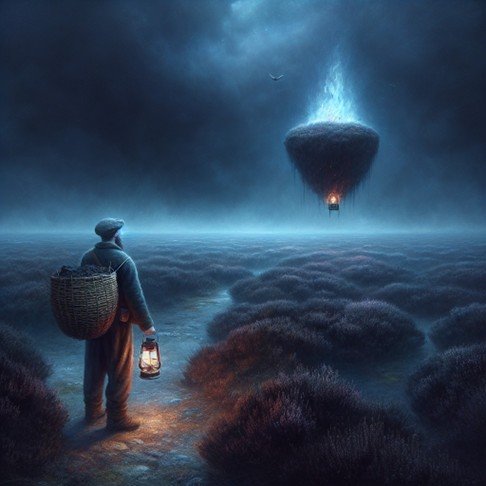
The Black Moss bordered south of the Dee, an open grave facing the sky. Mile upon mile of quaking peat, sphagnum swollen dark with water, pools that looked like pieces of fallen cloud, and the occasional raven spinning overhead as if it knew where the hard ground ended. In autumn the cotton-grass stood pale and trembling in whole drifts like the hair on an old man’s wrist. By November the frost had scoured it into a brittle sheen. No real road went through the Moss.
The old drove track was stubbornly made to the edge — a narrow string of gravel sewn between stone and the great sucking nothingness. Men used it by necessity, not because they trusted it. Some people spoke of the Moss in soft tones. To veer from the path after gloaming was to invite the spunkie, the corpse-candle — the wandering light that offered home and gave drowning. The old folk said the Moss remembered all the beasts and bodies it had ever taken. On quiet nights, when mist settled low and the peat took its sour, wet breath, the place seemed to think. It resented footsteps, even in daylight. By night it was a different country altogether: depthless, trackless, and hungry.
It was the late autumn of 1883, and Ewan Fraser was back from the regiment at Ballater. India had made him thinner, quieter; his skin weathered to a dark northern hue, his eyes holding the distant look of a man who had walked through horizons no map could touch. He had traversed punishing country in which the sun itself was an enemy, and slept under skies so immense a man felt like a pin dropped on the ground. But home unsettled him in ways the frontier never did. The air here was heavy with peat and damp stone and memory. The hills didn’t spread outward; they enclosed.
His mother had gone while he was away, taken by a fever that burned hot and left no mark but silence. Tam, his father, still held the croft above the Moss, though age had bent his back into a question mark. Ewan took over the work without complaint. He listened in the evenings to Tam’s tales — tales he had once considered old men’s fancy — and felt now a low tremor of cold recognition. Distance hadn’t made him believe. It had only made him less certain what should not be believed.
One evening, mist rising from the river like breath from a dying mouth and the sun bleeding low behind the Cairngorms, Tam urged him to fetch the last cut of peat from the stack in the valley beyond the Moss. “Take the lantern, lad,” Tam said. “And mind ye follow nae light but your own.”
Ewan smiled thinly. “I’m no green lad, Da. I ken the Moss’s tricks.”
Tam looked at him for a long time in the firelight, his face lined and the brown of old leather. “Aye,” he said at last. “But the Moss kens yours.”
The lantern was tin, its wick already blackened. Ewan turned up the flame and stepped out into the thickening dark. The air tasted of moist earth and rotting leaves, below it something metallic — old blood, maybe, or the iron taste that rose from cut peat after rain. He reached the stack just as the final smear of daylight bled down the west. He loaded the creel onto his shoulders and turned for home.
Then he saw it. A dim flame, smaller than a child’s cupped hand, hovering across the Moss thirty yards away. It bobbed softly, like a lantern swaying in a weary hand. Blue-white, cold as moonlight on snow, it floated away from him out into the black heart of the bog where the peat was deepest and the water had no bottom. Ewan stood motionless. He knew the tale: ignis fatuus, fool’s fire, the spunkie that brought all men to their doom.
Marsh gas, he convinced himself. Science had named it. He had seen men in the desert mistake heat for water, distance for deliverance. This was no different. The light drifted further, then stopped. His boots slipped off the gravel. The low peat-hags gave underfoot near the edge. The drove road folded behind him, and already the world had shrunk to that patch of light ahead and the dim ring of his own lantern at his feet.
The Moss changed quickly. Firmer ridges gave way to tremor beneath. Pools glimmered like obsidian mirrors, reflecting nothing — not sky, not star, not man. The lantern in Ewan’s hand flickered; the oil was running down. The will-o’-the-wisp halted over a wide flat of brilliant green sphagnum. Slowly it sank to the ground, burning like a cold star. Ewan took another step. Water quivered beneath the mat and rose around the edges of his boot.
Then from beyond the flame came a voice — thin, reed-like, familiar as his own blood. “Ewan.”
He stopped breathing. It was his mother’s voice, exactly as she had said his name the morning he left for the regiment: soft, weary, affectionate. “Ewan, lad. Come away home.” His throat closed. Five years gone, and now she was here, swept on the wind over the Moss. The ache of her absence opened in him all at once, raw as if no time had passed at all.
The light rose, glided forward, settled again. “Ye’ve wandered so far, son. The way is easy now. Come rest.” The peat softened further. Black water welled around his ankles, as cold as grave earth.
Then he remembered an old havildar on the frontier, talking by a low fire beneath a moon white as bone: Never follow what calls your name, sahib. It wears the face you most want to see.
He closed his eyes. “Mam,” he said gently, “ye’re no here.”
The flame leapt, stronger now, sharper. The voice came back, harder by a degree, grief curdling into need. “Ewan. Dinna leave me again.”
He opened his eyes. The will-o’-the-wisp burned fierce and cold, and for a single heartbeat it revealed a form that had been there all along: pale, half-formed face, dark hair lifted in no wind, eyes that were not his mother’s — hollow, old, patient as the Moss itself. The ground sucked harder. Ewan dragged one boot back, then the other, each step slow and measured, each step a fight against the lure behind.
The light drew back to arm’s length, never fleeing, never touching. He followed voices that changed with ease, like water changing shape: his father’s hoarse call from the byre; a comrade lost at Kandahar; a child’s laughter from the next glen. Every time his name. Every time the plea: stop, come, rest. He kept moving. Time thickened. Minutes lengthened strangely, blurred by mist and strain.
The lantern died completely and the darkness rushed close, leaving only the pale light ahead and the feel of the earth beneath his feet. Cold seeped through his stockings. His shoulders throbbed beneath the half-slipping creel. He could not tell whether he had been walking five minutes or fifty.
Then the ground shifted. Gravel crackled under his boots. The drove road. The light stopped at the border where peat and stone met, burning hot and cold with something like fury. Ewan turned. The will-o’-the-wisp flashed again — bright enough to burn its image into him. And before it died it was clearer now: not human, not fairy in any pretty telling, but hunger with patience. Then it winked out.
He headed home at a staggered pace, the half-empty creel rattling at his back. The cottage lamp burned evenly in the window, small and gold and entirely human. Tam opened the door, gave his son’s face a brief glance, and said nothing for a long moment. “Ye came back,” he said.
“Aye,” replied Ewan. They never quite spoke of it explicitly.
Yet after that evening Ewan never passed the Moss after dark. And when strangers inquired about the old tales, he said nothing save that the Moss had its own lights, and some promises were better left unanswered.
Years later, Ewan kept the same watch on the night Tam died alone. The candles stood at the bed’s four corners and a lantern burned beside the door. Outside, the Moss went silent under frozen frost. No flame appeared. No voice called. Only the wind across the peat, laden with the smell of cold earth and distant pine, and something else — something old and patient, waiting for the next weary soul to confuse its glow with home.