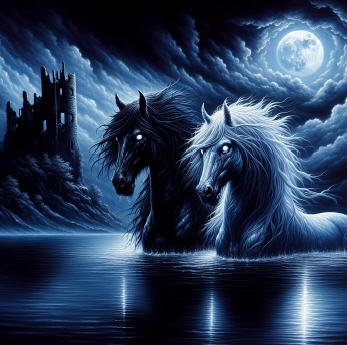
Seventeen-year-old Ewan MacGregor lingers too long by Loch Awe one misty night — and hears hooves on wet pebbles where no horse should be.
The mist came down early that evening, settling right across the heathered beds above Loch Awe, shrouding the moon when it pleased. The loch breathed with it. The dark water carried low reverberations until the surface shone like glass. Between that breath and rest, seventeen-year-old Ewan MacGregor sat watching, his breath a small cloud rising to a greater one.
He should have been home hours ago. His mother’s candle would be burning in the window — the same one his late father had carved from deer bone before he went off to war. But tonight, something had prevented Ewan from coming back down the glen. Something floating in the air, neither wrong nor right, but simply there.
They said the moon brought queer moods to the loch near its fullness. The village’s old men reported horses in the water, snow-pale and gleaming, stalking shorelines in search of wanderers. The younger lads laughed, but Ewan had grown wary of laughter. When he helped his uncle on fishing nights, he was certain that, though the air was windless, the boat tilted toward strange currents. More than once, he’d caught a glimpse — just from the corner of his eye — of something shiny moving beneath the black waterline. And now, alone on the loch’s edge, he could hear it: a low sound like a horse breathing from its nostrils, close but invisible.
Ewan wrapped his plaid closer and pretended the night air made him shiver. The mist thickened and veiled the moon. Everything folded inward, leaving only one soft rhythm — water lapping stone. Then another sound: hooves against wet pebbles.
He got up, heart beating like an echo. Ahead, in that flitting filigree of light where the moon grappled for freedom, a shape formed.
At first, he thought it was only a reflection — moonlight bending over mist. But amid the shifting gusts, the sight sharpened: a horse, black as peat, its mane snaking like smoke. Its eyes caught the moon, and the moon returned tenfold. The creature moved soundlessly apart from the water dripping from its flank. Within a dozen paces, it stopped and stared at him.
The horse was too polished to be real. Its coat shimmered like the loch itself, its breath forming small clouds that evaporated before touching the ground.
Then he spotted the others. One by one they stepped out from the lake — dappled grey and pearlescent white, the colour of moonlit ash. Slow and unhurried, they moved where the mist grew thinner, their bodies half real and half reflected. The air suddenly smelled of riverweed and rain.
“Who are you, then?” Ewan whispered.
The black horse dipped its head as though it recognised words. At the rear of Ewan’s mind, a warning stirred.
He recalled his grandmother’s voice, cracked and sure: Ne’er trust a horse that shines where no sun falls.
He moved one careful step back. The horse matched it forward. Moonlight quaked; the mist trailed off long enough to reveal the outline of an island in the middle of the loch. The ruins there — the remains of a clan’s keep burned back long ago — rose dark against the water. The horse raised its head toward that island and whinnied: too low, too gloomy for anything alive. An invitation.
Ewan’s pulse quickened. Something inside him — the same unease that had led him here — surfaced like tidewater. He walked a second step forward. The horse’s eyes brightened.
He reached out his hand. The hide met his fingers cool as riverstone, slick as the skin of salmon. A shudder rippled down his spine. A voice deep as the loch seemed to speak — not in his ears but in the back of his ribs: Ride and see.
He climbed on. The creature’s back was solid but yielding. The others turned toward the water.
They went over the loch as though the water was crystal, moonlight streaming through it like silver. The air held silence; the only sound was the smooth stride of the horses. Loch Awe, vast and black, devoured stars as they rode. The island emerged from the mist. The ruins loomed — strewn walls, ivy-ringed. The mist fell low and hid the ground.
Ewan dismounted, his feet trembling. The black horse had vanished into the mist. Only the faintest ripple remained where it had stood.
He walked among the ruins. Then he spotted movement — something glimmering in an archway. Tall and pale, a dress billowing like mist. Her eyes reflected the same strange light as the horse’s.
“Ye should not be here, son of MacGregor.” Her voice rippled, another voice beneath it, as if water itself spoke.
“I come only to see,” he said, trying not to sound afraid. “No harm meant.”
“The loch never asks harm. It only asks belonging.”
Ewan frowned. “Belonging?”
The woman’s lips formed a small, sad smile. “It remembers those who listen too long.” She moved closer. Her shoulders were damp, as if she had recently risen from great depth.
“Your father rode once,” she said. “Not here — but on the shore near Kilchurn, where mists rise just so. He heard the call and looked away.”
Ewan stiffened. “My father died in war.”
The woman’s gaze did not waver. “Perhaps. But his horse came from the water the next morning, wild-eyed and broken. Not all bargains ride home.”
The world around him pulsed, the loch’s breath echoing through the stones. The woman raised one hand and touched his cheek.
“The Kelpies come when the world forgets to be afraid of its own reflections,” she said. “Look too long into the loch, and it will not show you what is there — but what lurks beneath.”
He turned to the water. Below the surface, shadows tangled and moulded themselves — dozens of them, the dimensions of men drifting in imperceptible motion. The woman’s reflection rippled beside his own. But her reflection was not fair-skinned or mist-shrouded. It looked like the horse: dark mane-like hair cascading into the depths, mouth open with sharp teeth catching the faint moonlight.
He came to himself. The ruins looked smaller now, the mist closing in.
“Keep going,” the woman said softly. “Home, if you can still find it.”
He turned and ran. Behind him, as he glanced back once, a pale figure watched from the shore. Then the surface moved. Something climbed it — horse or woman, he could not tell — and the world froze.
Morning found him on the far bank, soaked to the bone, his plaid heavy with dew. The mist had thinned; Loch Awe shone in full daylight. There were no hoofprints on the shore.
He walked home through the heather, too exhausted for fear. His mother was at the door, saying his name in a trembling whisper.
She said little while drying his clothes and setting broth before him. But when he told her — in halting words — what he had seen, she only said:
“The MacGregors have always owed the loch a watchful ear. But not an answer, lad. Never an answer.”
That night, he dreamed of rippling water and the eyes of horses glinting like lanterns beneath its skin. Somewhere in that dream, a voice interrupted, neither gentle nor stern: “Some debts are owed with wonder, not coin. Keep to the banks, MacGregor. Count your blessings with your breath.”
He awoke at dawn, walked to the loch, and kept well back from the edge. The water was still. Yet deep down in his bones, he knew: the loch remembered.